

How Do Commercial Septic Systems Work?
At Colson’s Septic Services, we often get asked: “How do commercial septic systems actually work?” and “How is it different from a regular residential system?” The short answer: the principles are largely the same, but commercial systems are often larger, sometimes more complex, and must handle greater wastewater volume. Here’s a clear breakdown of how commercial septic systems operate — and why proper design, installation, and maintenance matter.
The Two Main Components: Tank + Soil/Drain field
Like conventional residential septic systems, most commercial septic systems consist primarily of two major parts:
- A septic tank (or a series of tanks).
- A drain field/soil absorption area (sometimes with a distribution box and network of pipes).
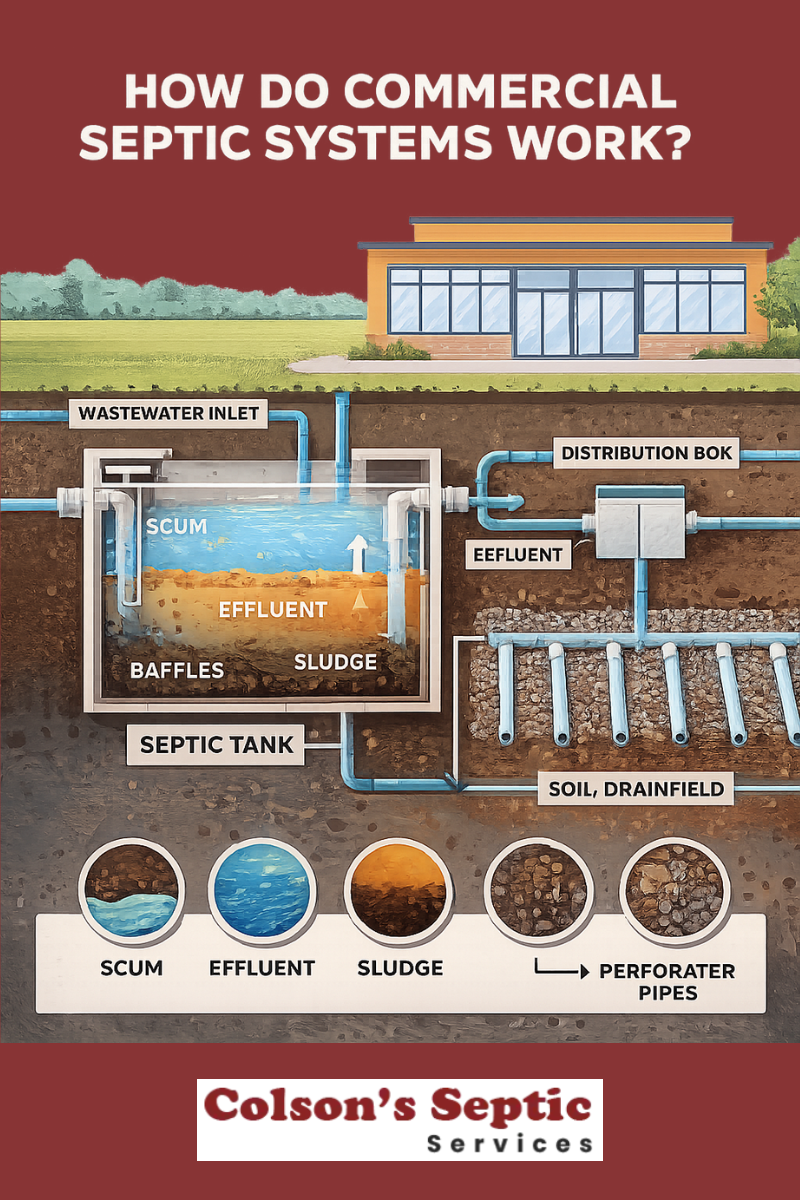
The tank is a buried, watertight container — usually made of materials like concrete, plastic, or fiberglass — sized to hold the volume of wastewater produced by the building.
From there, the wastewater flows into a drain field: a shallow system of perforated pipes laid in gravel- or sand-filled trenches — or sometimes more advanced alternatives, depending on soil conditions and system design.
What Happens Inside the Tank
Once wastewater from sinks, toilets, showers, kitchens, etc. enters the system, it flows into the septic tank (or first chamber, if multiple chambers are used) through an inlet baffle or tee.
Inside the tank, the wastewater separates into three distinct layers based on density:
- Sludge — heavy solids sink to the bottom.
- Scum — lighter materials like grease, oils, and soaps float to the top.
- Effluent — the liquid in between, which is relatively clearer and will eventually exit the tank.
Naturally occurring (often anaerobic) bacteria begin breaking down some of the organic matter in the sludge and scum layers. This bacterial action reduces the volume of solids over time, producing stable residual solids, liquids, and gases (like carbon dioxide or methane).
Importantly, a correctly designed tank uses internal baffles or T-shaped outlets to prevent scum and sludge from leaving the tank and entering the drain field. That helps avoid drain field clogging and system failure.
Moving Effluent to the Drain Field
Once the effluent (the clarified liquid) reaches a certain level, it exits the tank through the outlet — often passing through an effluent filter — and enters a distribution box (if the system includes one), which helps distribute the flow evenly.
From there, effluent enters a network of perforated pipes buried underground (the drain field or leach field). The effluent is slowly released through the holes in the pipes, into gravel- or sand-filled trenches, from where it gradually percolates into the surrounding soil.
This slow movement is essential: it gives the soil — and the microorganisms within it — time to filter and naturally treat the wastewater.
Soil: The Real Final Treatment
The soil beneath the drain field does more than absorb wastewater — it acts as a natural treatment system. As effluent filters through the soil layers:
- Physical filtration removes particles.
- Microorganisms in the soil further break down or neutralize pathogens and organic pollutants.
- Nutrients — like nitrogen and phosphorus — are reduced or immobilized.
- By the time the treated wastewater reaches groundwater, it is much cleaner and safer.
In many cases, most of the “treatment work” for a septic system occurs in the soil, not just the tank.
Commercial Systems: Extra Features & Considerations
Because commercial properties often generate larger volumes of wastewater — and sometimes wastewater containing grease, food waste, or other heavy loads — commercial septic systems may include additional design features not always seen in small residential setups.
For example:
- Grease traps or interceptors may be required ahead of the septic tank, especially if the facility includes kitchens or heavy food prep, so fats/oils don’t overwhelm the system. (Note: grease left untreated can float as scum, build up, and eventually clog pipes or drain field.)
- Some commercial systems may incorporate additional treatment stages — such as aeration chambers (to support oxygen-dependent bacteria), chemical dosing (for nutrient reduction), or even ultraviolet disinfection — to meet stricter effluent standards before discharge.
- The drain field design may need to account for heavier load, more frequent usage, or soil/site constraints, which may influence the size, layout, depth, and pipe/trench configuration.
At Colson’s Septic Services, when we design or service a commercial system, we pay careful attention to these variables — building in the proper capacity, filtration, and maintenance access so your system runs smoothly and stays compliant with regulations.
Maintenance: The Key to Longevity
Just like residential systems, commercial septic systems require regular maintenance. Over time, sludge and scum accumulate — and if not removed, they can overflow into the drain field or clog the outlet, leading to failures, backups, or environmental contamination.
That’s why commercial clients should schedule periodic inspections and pumping, and also be mindful of what goes down the drains (especially grease, oils, chemicals, wipes, etc.). Proper use and care significantly extend system lifespan and prevent costly repairs or replacements.
Moreover, for systems with advanced features (aeration, chemical treatment, filters, etc.), maintenance may also involve servicing pumps, replacing media, and ensuring all parts function as intended.
In Summary
Commercial septic systems — though built to handle larger volumes — operate on the same core principles as residential systems: a septic tank that separates solids from liquid, followed by a drain field and soil absorption area where natural filtration and microbial action finish the treatment.
However, because of increased load and sometimes stricter effluent requirements, commercial systems often need larger tanks, better grease and solids handling, and potentially extra treatment steps.
At Colson’s Septic Services, we understand what it takes to design, install, and maintain commercial septic systems that are efficient, environmentally responsible, and built for long-term reliability. If you’re considering a septic system for your business — or want to ensure your current system is properly maintained — we’re here to help. Contact us today, and we’ll make sure your wastewater is handled safely and effectively.